
Free Maths GCSE Retakes: Step-by-Step Online Guide
Unlock your future with our Step-by-Step Guide to Free Maths GCSE Retakes. Learn how to retake your GCSE Maths online for free and boost your career prospects.
EXAMS
Lincon
2/10/20264 min read

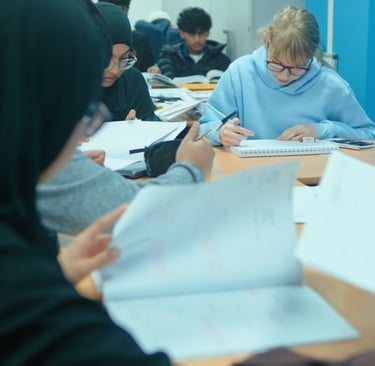
Step-by-Step Guide to Free Maths GCSE Retakes
Feeling like your Maths GCSE grade is holding you back? Whether it’s for a better job, an apprenticeship, or a university course, you are in the right place. The good news is that many adults can retake their Maths GCSE for free. This guide will show you exactly how.
This is possible thanks to government funding from the Adult Education Budget (AEB), which supports funded maths GCSE courses for adults. This means you are very likely to get a course for free if you meet two simple conditions:
You are aged 19 or over.
You do not already have a GCSE in Maths at grade 4 (or C) or higher.
So, if you're 25 and your highest grade is a 3 (or a D), you are almost certainly eligible for one of these maths GCSE retake funding options. To be 100% sure and get started, contact a local college. They will confirm your personal eligibility and guide you through the next steps.
Should You Retake Your GCSE or Do Functional Skills Maths?
While a GCSE is the qualification most people know, it's not your only option. Many adults instead choose Functional Skills Maths, a respected qualification focused on the practical, real-world maths needed for work and life. A Level 2 qualification in Functional Skills is officially recognised as equivalent to a GCSE grade 4 (what used to be a 'C' grade).
The main difference in the functional skills maths vs gcse debate comes down to focus. A GCSE is more academic, covering a broader range of topics like algebra, and is often the one required for university entry. Functional Skills, on the other hand, concentrates entirely on the kind of practical problem-solving you’d use every day.
Ultimately, the right choice depends on your goal. For university, a GCSE is usually the safer bet. For many jobs, apprenticeships, or college courses, a Functional Skills Level 2 is often perfect. The most important step is to check directly with the employer or institution to see what they accept.
How to Find and Enrol on a Funded Maths GCSE Course: A 3-Step Guide
Once you've confirmed that a GCSE is what you need, finding the right course is the next step. The government has created a straightforward tool to help. The National Careers Service course finder is the most reliable place to start your search for how to retake your maths GCSE for free, listing courses from colleges and training providers across the country.
Go to the official National Careers Service course finder website.
Type "GCSE Maths" into the course search box and add your postcode.
Browse the results for local colleges and online providers. Pay attention to start dates and whether the course is in-person or online.
Once you’ve found a promising option, contact the provider directly to enrol. Before you commit, it’s smart to ask about the weekly time commitment and if the final exam fee is included. Getting these answers will help you feel confident in your choice.
What Is an Adult GCSE Maths Course Actually Like?
Worried about being in a classroom again? An adult GCSE maths course is nothing like school. You’ll be learning with other adults who share your goal to improve their maths GCSE grade. Tutors specialise in helping people who may feel anxious, creating a supportive, no-pressure environment where questions are always welcome.
Your weekly commitment will depend on the course format. In-person classes are often one evening a week, providing helpful structure. Online courses offer more flexibility to fit around your life, but they do require self-discipline to stay on track and meet deadlines.
The course itself revisits core topics like Number, Algebra, and Statistics, building your skills from the ground up. Expect a fresh start, not a memory test. Once you feel confident with the material, the final hurdle is understanding the exam itself.
The Final Hurdle: Understanding Exam Boards and Key Dates
You might hear names like AQA or Edexcel mentioned during your course. These are simply different exam boards – the companies that create and mark the exams. Think of them like different mobile phone networks; they all do the same basic job, just with minor variations. Your college will have already chosen one, and your course will be perfectly tailored to its specific style, so you don't have to worry about the differences.
Crucially, you won’t have to figure out how to enrol for a GCSE maths resit yourself. As part of your free course, the college or provider handles all the exam registration paperwork for you. Your tutor’s job is to make sure you’re entered for the right exam at the right time, leaving you free to focus on learning.
GCSE maths exams happen in a set "window" during May and June each year. For those who need it, there is also a single resit exam date in November. Your college will schedule your course to prepare you for one of these sittings.
The Best Free Resources to Boost Your Revision
While your college course is the most important part of your journey, having extra support can make a huge difference. When you're stuck on a topic or just want more practice to help improve your maths GCSE grade, the internet offers some fantastic, completely free tools.
These two are widely seen as the best free maths revision resources:
BBC Bitesize: Perfect for clear, easy-to-read explanations and quick summaries of every topic.
Corbettmaths: Offers a short video, practice questions, and answers for almost every single thing on the syllabus.
If a particular area like fractions or algebra feels tricky, try this method: watch the Corbettmaths video, then read the Bitesize explanation to see it a different way. Using these tools alongside your course is a powerful way to build the confidence needed to meet the GCSE maths grade 4 pass requirements.
Your 4-Step Checklist to Getting the Maths Grade You Need
That feeling of being held back by a past grade can now be replaced by a clear, confident plan. Here is your simple step-by-step guide to getting your maths GCSE pass:
Confirm you're eligible (19+ and no prior grade 4/C).
Use the National Careers Service to find a free local or online course.
Enrol, attend, and use free resources to support your learning.
Pass the exam and unlock your next opportunity.
Whether it’s for a dream job, a university place, or personal pride, that grade 4 is now within your reach. This isn’t just about a certificate; it’s about opening a new door. Take the first, simple step on that path today.
Excel Tutors
Empowering young learners to achieve academic excellence through tuition.
Excel Tutors is a Limited Company in England and Wales with registration number 07417709.
© 2026. All rights reserved by Excel Tutors.
Designed, Developed and Maintained By Blueprint Design Lab